Intake cooling with a little help from the sun!
Heat stress leads to production losses and health problems. Since increased ventilation at high temperatures no longer provides any cooling, cooling must be achieved by other means. However, cooling with pad cooling or misting increases humidity, which is also undesirable. Kleventa provided a suitable solution.
The Challenge
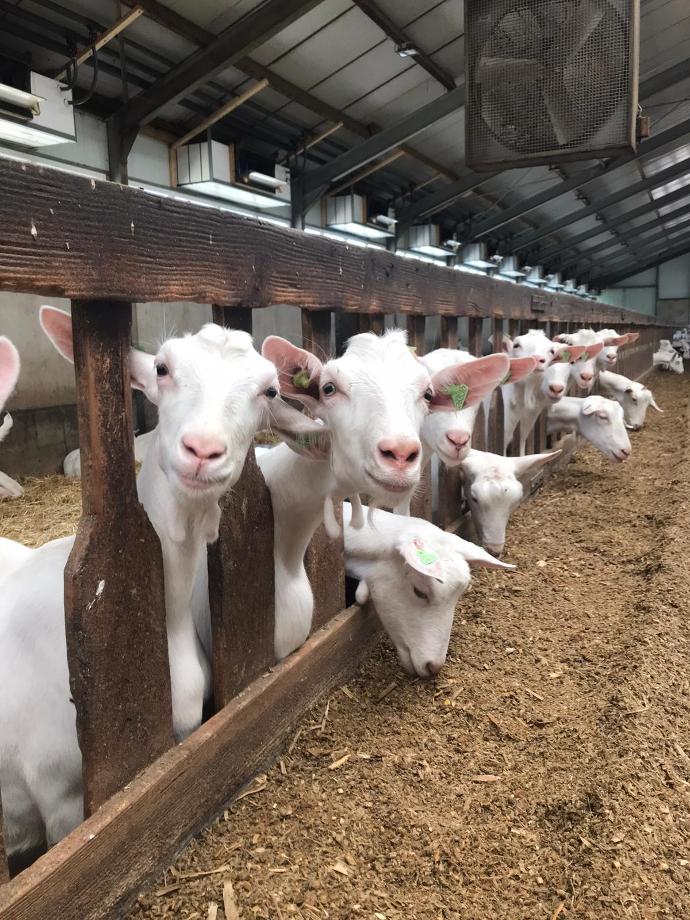
During the meeting between our sales representative Herbert Dijkman and Harry and Luc Selman, the issue arose that during the high temperatures of the summers of 2019 and 2020, milk production dropped dramatically. The barn is ventilated by fans in the ridge of the barn, and air enters through intake vents in the side walls. The misting system was running at full capacity to keep the temperature bearable, but rising humidity brought other problems to light. Furthermore, due to excessively high humidity and temperature, the acceptable THI index was exceeded, which puts the animals’ health at risk.

The solution for conditioning the intake
Kleventa provided the following solution: Lowering the outside air temperature. By ensuring that the outside air entering through the intake valves is cooled from 32 to 20 degrees, the barn temperature will remain at an exceptionally low level. This was achieved by installing Exegy Aerox heat exchangers in front of the intake valves. Cold water is pumped through the heat exchangers to cool the air, ensuring that the water does not come into direct contact with the intake air. Additionally, these heat exchangers can be supplied with hot water in the winter, allowing the intake air to be warmed when outdoor temperatures drop below 0 degrees.
Given that the cooling demand correlates with the outdoor temperature and the number of hours of sunshine, it was proposed to install solar panels tailored to the energy demand. This is a smart solution, as the energy monitoring and control system developed in-house by Kleventa ensures that the chillers only operate when there is sufficient solar output. As a result, the existing standard 80 A connection can remain in place, and any excess energy generated by the panels will be fed back into the grid.
The Installation
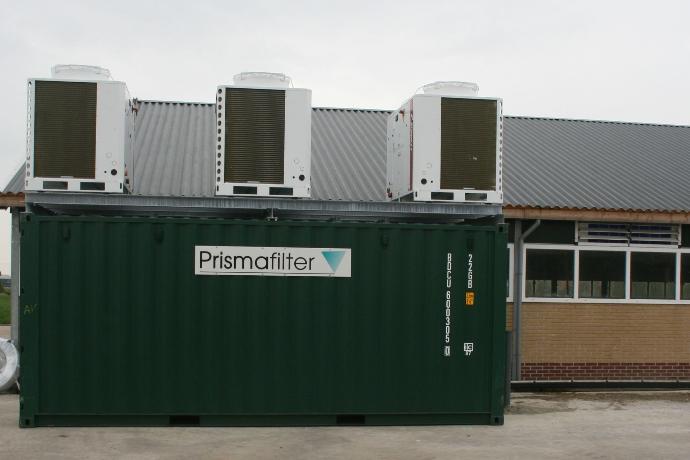
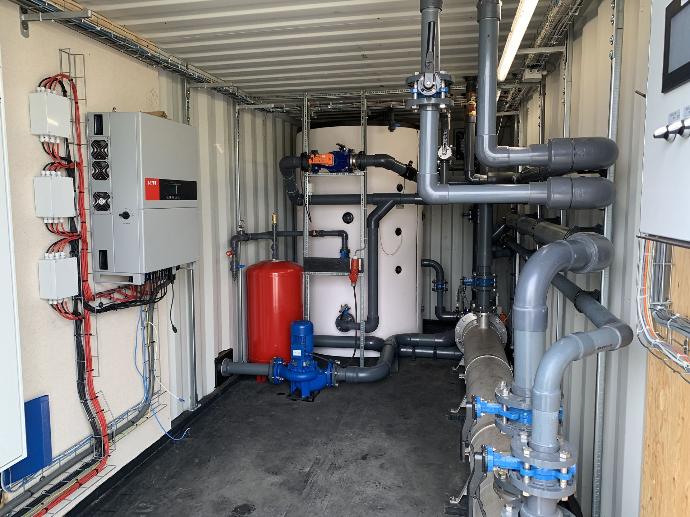
To ensure a smooth on-site installation, our partner Prismafilter developed the entire system as a prefabricated unit housed in a shipping container, which was then quickly installed on site. Of course, the entire technical system can be configured and monitored remotely. This type of climate control can be applied to multiple animal groups; Prismafilter has completed similar projects in pig barns, among other facilities.
Generating Heat and Cold
For this project, it was decided to use groundwater for pre-cooling, which provides a maximum of 120 kW. Further cooling is achieved using three 60-kW chillers/heat pumps. Together, this provides 300 kW of energy, which can be used to cool the inlet from 32 to 24 degrees. In practice, this is sufficient to prevent the problems mentioned. Because these chillers require more electric power than is available at this facility, alternative methods of generating electricity were explored.